End of arm tooling: Enhancing Precision in Automation



End of arm tooling: Enhancing Precision in Automation
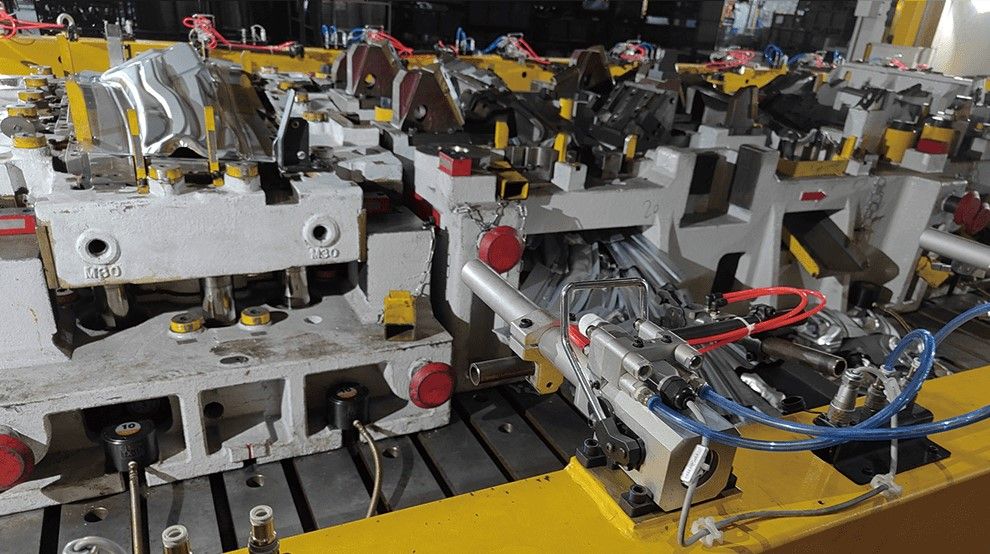
End-of-Arm Tooling (EOAT) refers to the tooling fixtures installed on industrial robots or manipulators that utilize vacuum suction cups or clamps to grasp workpieces and complete transfer operations, which plays a crucial role in industrial automation and smart manufacturing. EOAT typically consists of components such as the central boom, crosses, clamper or suction cups, tool-changer connectors, extension arms, and positioning blocks.
The material of EOAT varies according to the usage environment and application scenario. Common materials include aluminum alloy, steel, carbon fiber and polymer materials, etc.
There are many types of stamping EOATs, but according to their working principle, they can be divided into 4 categories: mechanical clamp type, vacuum suction cup type, permanent magnet adsorption type and electromagnetic adsorption type.
1. Mechanical clamp type: Using mechanical jaws to provide the clamping force to pick up workpieces. It can pick up workpieces with different shapes and materials, but its relatively complex structure increases the weight of the EOAT. Additionally, the higher clamping force may lead to scratches on the workpieces.
-
Vacuum suction cup type: Using the negative pressure generated at the end of the suction cup when working to pick up the workpiece. It can absorb copper, aluminum and other non-magnetic materials, and does not scratch the surface of the workpiece. However, it cannot pick up workpiece with uneven surfaces or holes, and the suction cups are easy to wear out.
-
Permanent magnetic type: Using the magnetism of permanent magnet to pick up the workpiece; small size, energy saving and environmental protection, but the time of magnetization is limited.
-
Electromagnetic type: Using the suction force generated by the electromagnetic field to pick up the workpiece, can control the adsorption force by turning on/off the power, but can only pick up the workpiece with magnetic material.
Aotto's EOAT can adapt to complex environments, improve the stroke and production efficiency, enhance workpiece gripping accuracy and automation, and reduce labor costs. It is widely used in stamping, manufacturing, assembly and other fields. According to the matching automation form, they can be divided into tandem line tooling, hot stamping line tooling and transfer line tooling; according to the specific function, they include destacking tooling, loading tooling, transfer tooling and unloading tooling.
Key Considerations for EOAT:
Maximum press opening and worktable surface;
The size and weight of the product;
Idle station and double blank detection;
Interface type of the EOAT;
Component quantity and configuration
For more information, visit our website or contact Aotto's team.
Looking for something else? Contact Aotto and our team will be happy to help.